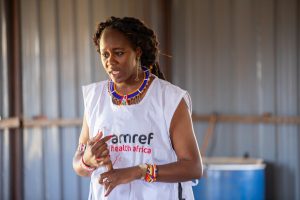
By Cynthia Simanti Oning'oi
Project Associate, Amref Health Africa Kenya
As a survivor of FGM/C, I know what the cut really means for a girl or young woman whose life is still ahead of her. It represents the end of her innocence; the end of her childhood. It cuts not only her body, but also her future, making it more likely that she will drop out of school. It increases the risk of her being married at a young age, and becoming pregnant before she is ready.
Today, at 31, I am a fun-loving, curious person who loves to travel, to make memories, and to meet new people. I am doing a job that I love. This is my wish for every girl.
The time to talk in safe and honest spaces
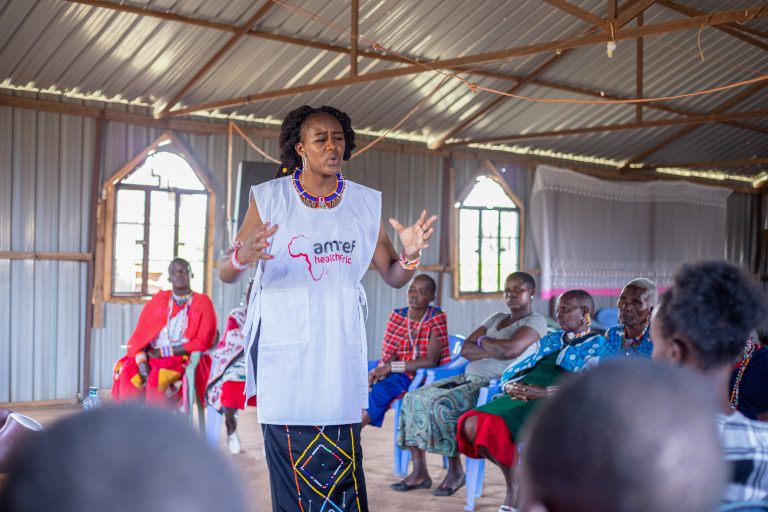
What is unique about Amref Health Africa’s work to end FGM/C is the space and time we devote to dialogue with communities. Conversation is at the heart of our end-FGM/C programming across the continent, from Kenya to Senegal.
First of all, we make sure that the dialogues are compatible with participants’ daily lives and their other commitments. Some days, you will arrive in a community and the women will say to you: “Start with the men while we finish up with our household chores; as we load up the donkeys with water, as we finish up feeding the children”. So we might begin by having conversations with the men, and then later in the afternoon the women start showing up. By the time they come to the dialogue they have finished their day’s work and they can sit, relaxed under the tree and be ready to listen and to share their views. It also means they feel respected.
When we hold a dialogue, we spend the whole day with the community. And that is very deliberate: these conversations cannot be rushed. It takes time to build trust. You need to allow time for people to ask questions, for them to give their feedback, for them to process their emotions – and even for them to get mad at you.
Knowing all this, we always begin a dialogue by making clear that this is a safe space. We tell participants: “You can talk about everything that has always been in your heart, without judgement”. In my experience, people – especially the elders – will begin by doubting you. Then, once someone asks a tough question, they will monitor your reaction to see how dismissive or accommodating you are. The way you nod your head, the way you move – just small motions – will tell them whether or not they can trust you. Once they do, they will start opening up.
What is unique about Amref is that we don’t look at what time we get back home at the end of the day: we look at the impact we had on that day. As a survivor, that’s what I really appreciate.
Hard to hear
Of course, these conversations can be hard, too. They call into question a lot of things that communities believe about themselves and their histories. They force communities to reconsider the value they place on some of their members, especially girls and women. Remember, we are talking about putting an end to a practice that is so integral to the community’s culture that no-one who is alive today remembers when or why it began.
These spaces are designed to be safe for communities – but they can be hostile to survivors, especially at first. I have had people say ignorant and hurtful things to me. These things are hard to hear: you can feel like they don’t care about what you’ve been through, or about their young girls. But I know that they stem from a lack of understanding. It’s this understanding that I seek to improve through my work.
As a facilitator of these dialogues – and especially as a survivor – you have to constantly remind yourself that it takes time for people to change their perceptions. You have to be ready to take these blows and not give up on engaging them. That’s why it’s vital to have a professional side that protects you: a kind of built-in shock absorber.
"My scars are what drive my work"
Different kinds of knowledge
My passion for my work goes hand-in-hand with my skills. This role is a natural fit because I am a warm and curious person. Then there is my lived experience: I am a survivor, as well as a member of the communities I serve. And then there is the academic, technical expertise I bring from my degree in gender and development studies.
The survivor part is very much key in terms of what drives me: waking up every morning and doing the same thing, however hard it might be, because you know how much damage it can cause to those young girls. For me, the scars are the drivers behind my continuous engagement with communities.
I am engaging with Maasai communities as someone who understands their culture. There are things that no-one from outside a community can know or understand: so much information that is not on any social media, on any platform, on any paper. But being a young woman comes in these spaces with its challenges. If a participant asks you a question and you are unable to answer them, then you lose their trust. But when you are rich with knowledge, the community also learns things. They begin to respect you – and they feel respected. They now look at you as someone who has really taken time to prepare for the conversation and not come here to waste their time.
It is demanding work: there is so much that is needed from you as a person. I feel so blessed because I am not alone: by now, we have trained several champions, and I draw strength from them.
Emerging threats, evolving responses
One of the saddest things that I have observed in recent years is communities who are lowering the age at which children are cut. Recently we were doing an exercise to prepare for an Alternative Rite of Passage (ARP) ceremony, and we found an 8-year-old who had been cut. In the Maasai culture, an 8-year-old should not have gone through FGM/C.
This shift is, in a way, testament to the success of the awareness-raising work that has been done by Amref and other organisations. Today, most children in schools are empowered: they know their rights; they even know the hotline number to call if they or someone they know is at risk. Children – especially the small ones – always tell their mums what they learned in school at the end of the day. Then the women talk about it among themselves, and this triggers the older women who are responsible for cutting. They become scared that the girls will resist, and so they cut them before that becomes possible.
To challenge this trend, Amref is advocating for the integration of end-FGM/C messaging into ante-natal care. As in so many situations, the best way of preventing harm is to act early by strengthening the provision of information and care at primary level. Even if you are a first-time mum, you will already know that your daughter has dangers awaiting her in society, and you should be empowered to decide that you’re not going to allow anything to happen to her. If we do not act to address this issue of early cutting, we are looking at a situation where the Maasai community might end up performing FGM/C at birth, as in some other countries.
The second shift I am seeing is the growth of medicalisation. Increasingly, parents are taking their daughters to be cut at a facility in the hopes of sparing them pain. So now we are seeing medical doctors and nurses performing FGM/C on children. Most health workers are not even taught about FGM/C during their studies – so when they are approached by a family willing to pay, they might be tempted to do it without realising the damage they are causing.
As a result, Amref Health Africa is advocating for FGM/C to be introduced in the nursing and medical curriculum, so that health workers are aware of the dangers. We are also calling for the introduction – and the implementation – of penalties for health workers and facilities that agree to perform FGM/C.
Where we go from here
I remain optimistic that we can end FGM/C. To me, the key to success is listening to the communities, as well as being ready to unlearn some of the things that we think have been working. Very often, NGOs are guilty of taking a top-down approach: we come up with strategies without consulting communities to see what approach is best for them. I feel like as you write the project proposal – and this is also something that is affected by being donor-reliant – if you take a certain angle and start writing the truth about what can really, really work for communities, you might end up not getting the funding. So you start writing what you think the donor wants to hear, and then you have really missed the mark.
Ending FGM/C is like climbing a mountain. Sometimes, when you look up, the peak is hidden by clouds – but even when we can’t see it, we know it’s there. And when I feel discouraged by the path ahead, I look at the girls we have already helped to protect. Just being able to see those girls having the right to enjoy the full potential of their bodies and their lives. Nothing should cut them off.
My greatest fulfilment is to see the girls being able to reach their full potential, as I am doing.
Banner image: Cynthia Simentoi Oning’oi with a Maasai elder, in Maparasha, Kenya (c) Amref Health Africa/Esther Sweeney